

Cloud-based device management software
See your entire device ecosystem, keep inventory details current, and track lifecycles effortlessly.
No credit card required
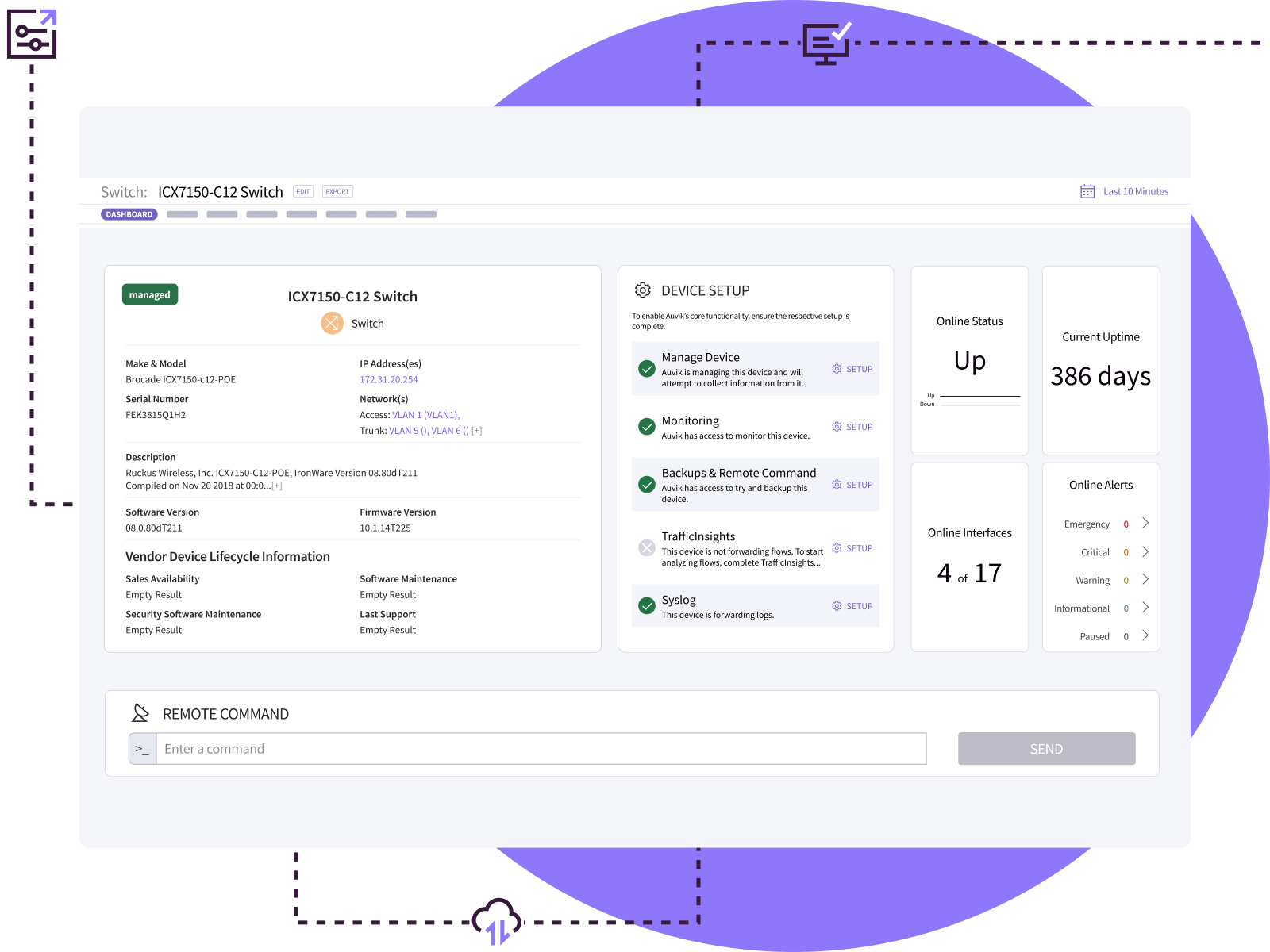
Key use cases of Auvik’s device management software
Auvik’s device management software helps IT teams solve some of the most common and costly network challenges. From discovering every connected device to maintaining hardware health and improving real-time visibility, these use cases show how Auvik streamlines network management and strengthens security.
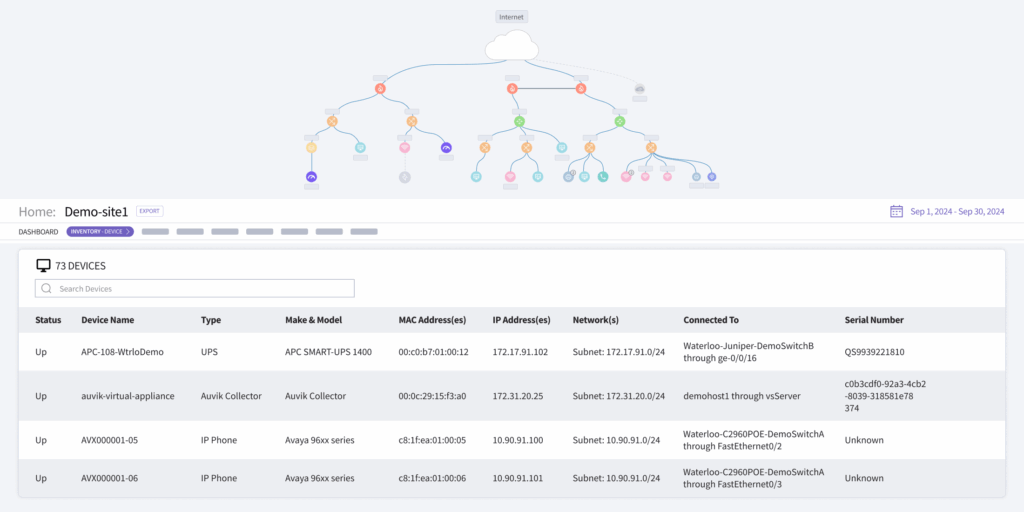
Find every device on your network in minutes with automated device discovery
When managing a complex network, it’s often difficult to know exactly what devices are connected, how they’re linked, and where they’re located. Manually tracking them is slow, error-prone, and can leave critical equipment unaccounted for.
Auvik’s automated device discovery finds every device on your network automatically and maps them in real time using protocols like CDP and LLDP. It captures key details such as make, model, serial number, and physical port, and lets you locate any device instantly with intelligent search. This gives you a complete, always-accurate view of your network, saves hours of manual work, and ensures nothing is missed.
No credit card required
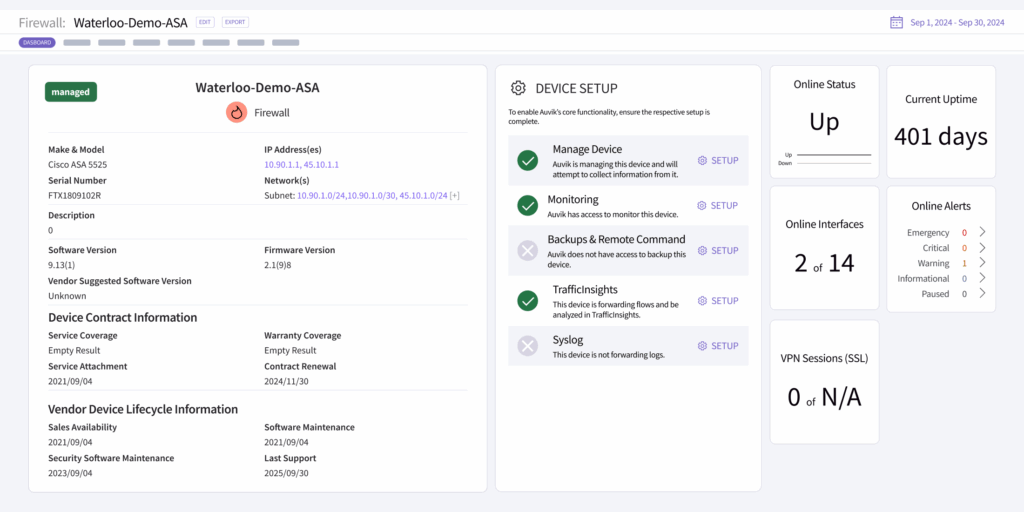
Keep your IT inventory always accurate and up to date with inventory and asset management
Managing network hardware across multiple sites can quickly become unmanageable when asset data is scattered or outdated. Without accurate records, IT teams risk keeping end-of-life devices in production, missing security updates, and wasting budget on poorly timed replacements.
With Auvik’s cloud-based inventory and asset management, all device information — make, model, serial number, IP address, and physical port — is collected automatically and kept up to date. You can easily flag outdated hardware and confirm update eligibility, allowing you to plan replacements and upgrades strategically. This reduces security risks, improves operational efficiency, and ensures you’re working from a single source of truth.
No credit card required
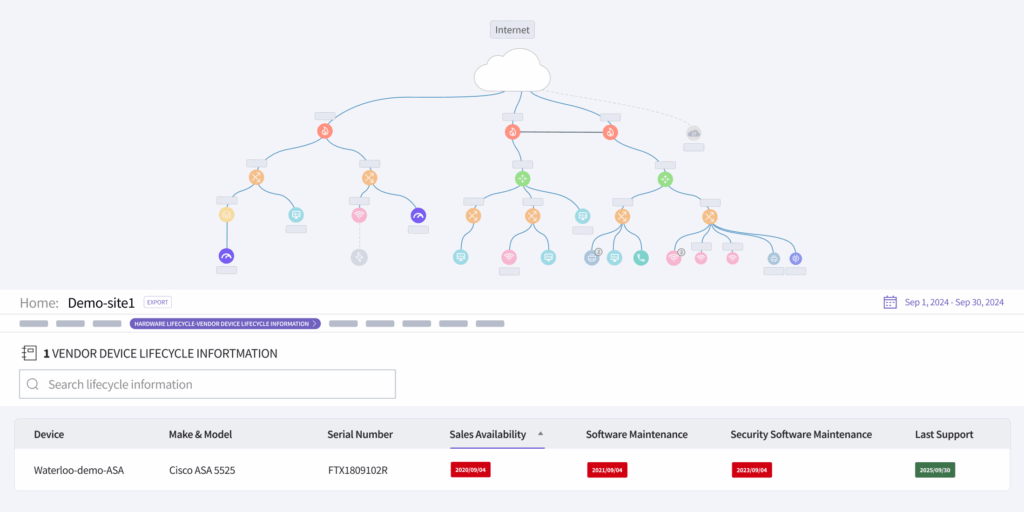
Proactively replace aging hardware before it fails with hardware lifecycle management
If hardware lifecycle stages aren’t tracked, devices can remain in service past their end-of-life or end-of-support date. This leads to missed security patches, compliance violations, and increased downtime risk — all avoidable with the right oversight.
Auvik’s hardware lifecycle management shows you the device age, support status, and firmware versions. You can identify and prioritize replacements before devices become liabilities, and reliably perform critical security updates. The result is a more secure, stable, and compliant network without last-minute surprises.
No credit card required
Spot and resolve issues the moment they happen with real-time network visibility
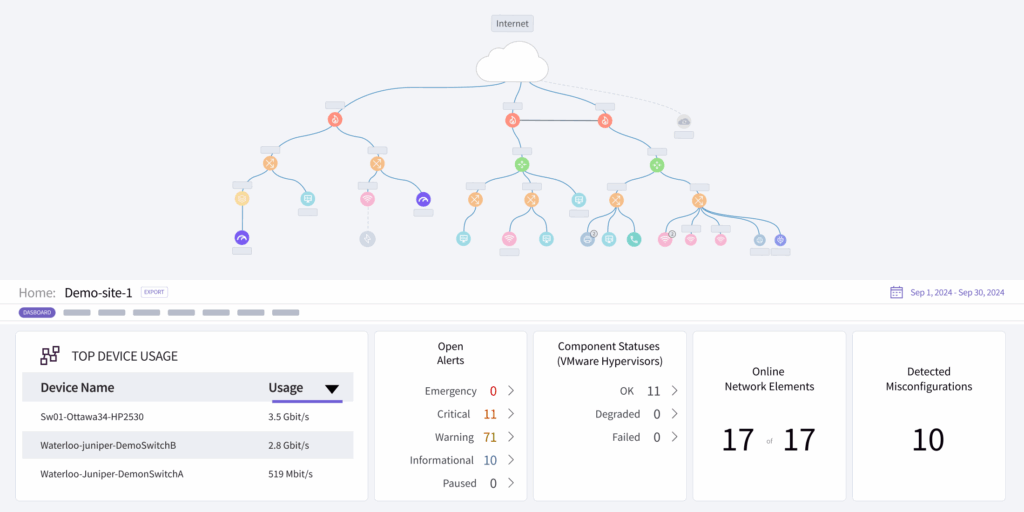
Troubleshooting blind is costly — performance issues can go unnoticed until users complain, and without live insight into your network, finding the root cause becomes guesswork.Auvik’s real-time network visibility gives you a live topology map and a centralized dashboard showing every device, its connections, and performance data. Automatic mapping and inventory tracking let you spot issues the moment they occur and understand exactly how they impact the network. This minimizes downtime, speeds up problem resolution, and keeps your network running at peak performance.
No credit card required
See your entire network — mapped & monitored
Every device, site, and connection—clearly visible, always up to date.
- Instantly create a live map of your network
- See every device and connection in one place
- Get automated alerts to detect issues fast
- Achieve full network visibility in under an hour
Start my 14-day free trial
Learn more about device management at Auvik
What is device management?
Device management is the practice of discovering, monitoring, and securing every device connected to your environment, including core network infrastructure like switches, routers, and firewalls to servers, workstations, and other endpoints. Auvik’s cloud-based platform automatically finds each device, maps how it’s connected, and keeps its inventory details up to date. From one dashboard, you can view device health, track configurations, monitor performance, and resolve issues before they cause downtime or security risks.
What sets Auvik’s device management software apart?
- Automated discovery & mapping: Auvik scans your network using SNMP, CDP, LLDP, and other protocols to auto-discover devices, map their connections, and maintain up-to-date topology and inventory documentation.
- Comprehensive asset intelligence: Captures inventory details such as make, model, serial number, IP address, firmware, and port connectivity.
- Cloud-based, scalable solution: Delivers platform updates automatically, requires no on-premises infrastructure, and provides access from anywhere.
- Continuous oversight: Monitors hardware lifecycles (EOL/EOS), system health, and configurations over time.
How does Auvik discover and manage devices?
Auvik deploys a collector — a lightweight agent installed on your network—which scans the local subnet and beyond using ARP tables, forwarding tables, VLAN information, and discovery protocols such as SNMP, CDP, LLDP, and CLI. Auvik then maps both physical and inferred network connections, visualizing wired and wireless relationships.
What types of devices can Auvik manage?
Auvik supports discovery and management of a broad range of devices, including (but not limited to): routers, switches, firewalls, wireless controllers, access points, servers, workstations, printers, hypervisors, IoT devices — from more than 15,000 device types across 700+ vendors.
Is Auvik cloud-based or on-premises?
Auvik is a cloud-based solution. You only need to deploy the lightweight collector within your environment. The platform provides secure, remote access, automatic updates, scalable infrastructure, and a unified management interface without on-site servers.
Does Auvik support BYOD (Bring Your Own Device)?
Auvik can discover and identify employee-owned devices like tablets, phones, or laptops. However, it doesn’t provide traditional MDM/EMM-style “containerization” or app/data segregation for BYOD — it treats these as unmanaged or non-billable assets.